
Heat Wave photochromic safety glasses use a UV-reactive lens that stays near clear indoors and darkens to sunglass tint outside, offered on the Future Tech, Vise, Performance Vise, XL Vise, Performance Lazer Face and Performance Rayth. The Future Tech is the flagship for a medium to wide face, and the Vise Photochromic is the value pick and the only one with a side-shield option.
Most safety glasses make you pick a side. Clear lenses pin you to the shop and leave you squinting the second you step into the yard. Dark lenses do the opposite, great in the sun and useless the moment you walk back under a roof. If your day moves between the two a dozen times, you end up either swapping pairs or pushing one up on your head and going without protection where you need it most. Photochromic lenses are the answer to that specific problem. Most people just call them transition lenses, since that has become the generic name for any light-adaptive lens, not a claim about a specific brand. Heat Wave's version runs on the same idea: UV-reactive photochromic chemistry built into the lens itself. One lens that reads the light and adjusts, clear indoors and tinted outside, all on a frame that still carries the Z87 stamp. Heat Wave Visual builds a deep photochromic line, and the trick is knowing which model actually fits your face and your work.
What photochromic means on a Z87 frame
A photochromic lens has molecules baked into it that react to ultraviolet light. Step into sunlight and the UV triggers them, the lens darkens, and you get sunglass-level tint within seconds. Walk back inside and the UV drops away, so the lens fades back toward clear over a minute or two. There is no battery, no button, nothing to charge. The lens is the whole system.
The part that matters for a work pair is the rating underneath all that. Heat Wave's Performance and Future Tech photochromic models are marked Z87+, which is the high-mass and high-velocity impact standard set by ANSI, not the lower basic-impact line. The standard Vise, XL Vise and Lazer Face photochromic builds are marked Z87 and reach Z87+ with add-on side shields. That plus sign is the difference between a fashion sunglass and something you can legitimately wear on a bay floor or a jobsite. If the markings on safety eyewear are a blur to you, the breakdown in our guide to what the Z87.1 mark actually means is worth five minutes. The short version: Z87+ on the frame and lens is what you want, and Heat Wave stamps it on its Performance and Future Tech photochromic frames.
The Heat Wave photochromic lineup
Heat Wave spreads photochromic across most of its core shapes, so the choice comes down to fit and coverage more than lens tech, since the lens behaves the same across the range.
The Future Tech Photochromic is the flagship and the one to start with. It runs $112.50, with an optional adjustable nose pad pack that brings two extra sizes for $117 if your bridge sits oddly. The Future Tech is a larger, modern wrap that suits a medium to wide face and gives you real coverage at the edges. There is also a Vapor Clear Frame version at $125, which is the frame that keeps showing up in search for people hunting a clear-framed photochromic Z87. If you like the see-through frame look, that is the one.
The Vise Photochromic is the value pick at $72, and it is the model Heat Wave buyers ask about most by name. It is a flatter, more classic shape than the Future Tech, one styling choice among several the standard Vise line offers, and it has a feature the others do not: a side-shield option. For $9 more you can add Z87+ VISE side shields in black, smoke, or clear, which closes the gap on the temples for dust and debris coming in from the side. That makes the Vise the most genuinely jobsite-ready photochromic frame in the line.
If you want maximum wrap, the Performance Lazer Face Photochromic at $108 is the big, aggressive shield shape that hugs the face and blocks light and wind from the sides without add-ons. The Performance Rayth Photochromic at $90 goes the other direction, a sleeker, lower-profile frame for a smaller face or anyone who finds the bigger wraps too much glasses. There is also a Performance Vise Photochromic at $90 and an XL Vise version at $94.50 for wider heads, so the same shape scales up if the standard Vise pinches.

The whole point of photochromic is that the glasses you put on at 7am are still the right glasses at noon and at 5, without you ever thinking about it.
Where photochromic wins, and where it does not
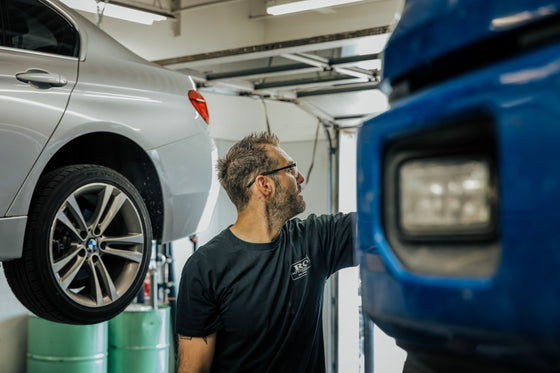
Photochromic earns its money for anyone who crosses the threshold between inside and outside all day. Auto and tire technicians pulling cars in and out of the bay, landscapers moving between shaded equipment and open turf, line crews stepping from a truck cab into glare, anyone whose light changes hour to hour. You stop choosing between protection and comfort because the lens makes the call for you.
There are two honest limits worth knowing before you buy. The first is driving. Photochromic lenses react to UV, and most modern windshields filter out a large share of UV, so the lens will not darken to full sunglass tint behind the wheel. It still tints somewhat, but if your main need is a driving sunglass, a fixed polarized lens is the better tool. The guide to Heat Wave frames for bright sun covers the fixed-tint and polarized options for steady, all-day glare.
The second limit is the pure indoor worker. If you spend your whole shift under shop lights and never see the sun until you clock out, you are paying for a feature you will not trigger. A dedicated clear lens is lighter on the wallet and gives you full clarity with no tint at all. We laid out those picks in the clear-lens safety glasses guide. Photochromic is for the in-and-out day, not the all-indoor one.
Picking your pair
Fit decides this more than anything. A medium to wide face that wants modern styling lands on the Future Tech. A buyer who wants the best price and a classic look, plus the option to seal out side debris, takes the Vise with its side shields. A big head or anyone who wants the most coverage goes Lazer Face or XL Vise. A smaller face or a lighter feel goes Rayth. Every one of them ships Z87 rated with the same adaptive lens, and the Performance and Future Tech builds carry Z87+, so there is no wrong lens, only a wrong fit.
For the wider Heat Wave picture, including the non-photochromic tints and mirrors, the full Heat Wave Visual buyer's guide walks through the whole catalog. And if you are kitting out a crew rather than buying one pair, photochromic is a strong default because it cuts the number of lens choices a manager has to make, which is exactly the kind of decision OSHA's eye and face protection standard pushes employers to get right.
Common questions
Are these the same as Transition lenses?
“Transition” is the everyday word most people use for any lens that lightens and darkens on its own, not a Heat Wave product name and not the licensed Transitions® brand. Heat Wave's photochromic lenses work the same way, UV-reactive molecules built into the lens, so if you are searching for a lens that goes from clear to tinted without swapping glasses, this is that lens.
Are photochromic safety glasses actually Z87 rated?
The Heat Wave photochromic models are, yes. Each one carries a Z87 mark, and the Performance and Future Tech builds carry the Z87+ mark for high-velocity impact, the same marks the brand puts on its clear and tinted frames. Always check for the Z87 mark on the frame and lens, since it separates true safety eyewear from a fashion sunglass. The full standard is published by ANSI.
How long do photochromic lenses take to change?
Darkening is fast, usually a matter of seconds once you step into sunlight. Clearing back up is slower, often a minute or two, because the molecules take longer to relax than they do to activate. Cold weather tends to make them darken a little deeper and clear a little slower.
Will they darken while I am driving?
Not fully. Most windshields block much of the UV light the lens needs to react, so behind the wheel you will get partial tint at best. For a true driving sunglass, look at a fixed polarized lens instead of photochromic.
Which Heat Wave photochromic model is best for a tire or auto shop?
The Vise Photochromic with the optional side shields is the most shop-ready, because it adds side coverage for dust and flung debris at a reasonable price. The Future Tech is the better pick if you want a larger, more wraparound frame straight out of the box. If the job throws more dust than side shields can handle, the MXG-250 moto goggles run the same photochromic lens in a fully sealed goggle.
If your day refuses to stay in one kind of light, a photochromic pair is the closest thing to set-and-forget eye protection on the market. Browse the full range in the Heat Wave collection and match the frame to your face, the lens will take care of the rest. If you want to compare against other Z87+ brands, the full Z87 safety sunglasses collection lines up Heat Wave next to Wiley X, Smith, Spy, and Oakley Standard Issue.