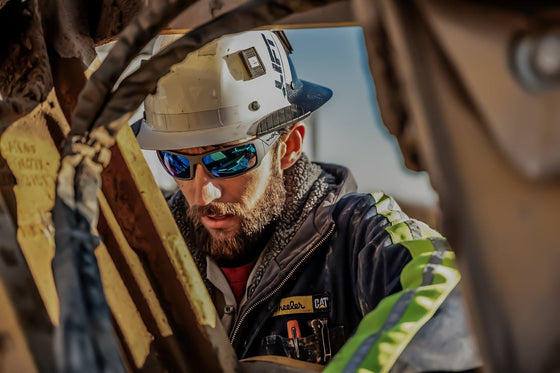

The best clear-lens safety glasses for indoor and shop work carry the Z87 or Z87+ mark, an anti-fog coating, and a light frame people will keep on all shift. Our picks are the Wiley X Climate Control series including the Z87+ rated Enzo, the ANSI Z87.1 rated Spy Bounty, and the lightweight Wiley X Saber and Guard.
Clear lenses are what you reach for when the hazard is real but the sun is not. Inside a shop, a warehouse, a bay, or a plant, you still have grinding sparks, flying debris, brake dust, and chemical splash coming at your eyes, but a tinted lens just makes the work darker and the corners harder to read. A clear Z87 lens gives you the impact protection without stealing the light. Here is how to pick clear-lens safety glasses your crew will actually keep on indoors, and the one feature that matters more inside than out. That is about lens tint, not frame color, a different pick covered in our clear frame guide.
Why clear, and why Z87
Indoor light is flatter and dimmer than daylight, so a dark lens works against you under fluorescent tubes or in a back bay. Clear keeps your color and depth intact while the lens and frame still carry the Z87 or Z87+ impact mark that any real eye hazard demands. The mark is the whole point, and you can confirm the standard at ansi.org. A clear lens without it is just glasses. Our clear-lens collection filters to frames that pass impact, and the broader Z87 safety collection shows the full rated lineup.

The feature that matters most indoors: anti-fog
Outdoors you get airflow. Inside, between body heat, a mask, and warm shop air, a lens fogs and people push the glasses up onto their forehead, which is the same as not wearing them at all. Anti-fog is the difference between a pair that stays on and a pair that lives on a hat. Smith built its name on anti-fog coatings, and most quality clear lenses now carry some version. If your bay runs hot or humid, treat anti-fog as non-negotiable, and our guide to keeping safety glasses from fogging covers the rest.
Clear picks worth stocking
Wiley X Climate Control series, including the Enzo. A removable Facial Cavity seal blocks dust and debris, and the clear lens option suits gritty indoor work like brake jobs and woodshops. Z87+ rated, with a gasket you can pull out when you do not need it.
Spy Bounty. A Grilamid frame that is close to indestructible, ANSI Z87.1 rated, available with a clear lens and in prescription, one of the models in our Spy Optic buyer's guide, alongside the rest of the Spy Optic lineup. A clean, low-profile pick for techs who want one durable pair.
Wiley X Saber and Guard. Lightweight wrap-style frames offered with clear lenses and interchangeable options, long issued as workplace safety eyewear. Easy to wear a full shift.
Most of these run a few dollars more than a bin pair of clear safety glasses, and they keep working past the point where the cheap ones crack, scratch, or get tossed in a drawer.
The best indoor lens is the one nobody pushes up onto their forehead. Clear, anti-fog, and comfortable beats dark and dramatic every time you are under a roof.
Clear versus a light tint
If your crew moves between an indoor bay and an outdoor lot all day, a clear lens covers inside and a light tint or photochromic lens bridges both. For pure indoor work, stay clear. For mixed work, keep a clear pair at the bench and a comfortable everyday pair for the yard, or run photochromic if you hate swapping. The hazard does not change indoors, so the rating should not either.
Fit for a full shift
Clear lenses get worn longest because they go on at clock-in and stay until clock-out, so comfort decides whether they last. Rubber nose pads, light frames, and temple grip keep them put through bending, lifting, and looking up under a vehicle. If techs wear prescriptions, a clear Rx-ready safety frame or an over-the-glasses style keeps them compliant without the squint.
Common questions
What are the best clear safety glasses for indoor work?
Look for a clear lens with the Z87 or Z87+ mark, an anti-fog coating, and a light, comfortable frame. The Wiley X Climate Control models, the Spy Bounty, and the Wiley X Saber or Guard are durable picks that hold up to a full shift.
Do clear safety glasses need to be Z87 rated?
If there is any eye hazard, yes. Clear or tinted makes no difference to impact protection, and the Z87 mark on the frame and lens is what certifies it. A clear lens without the mark is not safety eyewear.
How do I stop clear safety glasses from fogging indoors?
Start with an anti-fog lens, keep the glasses on rather than on your forehead, and use an anti-fog wipe or spray on humid days. Airflow matters less indoors, so the coating does most of the work.
Can I get clear safety glasses in my prescription?
Yes. Several clear frames, including the Spy Bounty, are prescription-ready, and a crew program can fit the whole team at once. An over-the-glasses style is the other compliant option.
Coatings that matter beyond anti-fog
Anti-fog gets the headline indoors, but two more coatings decide how long a clear lens lasts. A hard scratch-resistant coating is the one that keeps a lens usable past a month in a pocket full of keys and shop rags, because bare polycarbonate scratches fast. An anti-reflective coating cuts the halos off overhead lights and screens, which is the indoor version of glare and a real help at a parts counter or a bench. Most quality clear safety lenses ship with scratch resistance standard, and the better ones layer anti-fog and anti-reflective on top. When you compare a five-dollar bin pair to a Wiley X or Spy clear lens, the coating stack is most of what you are paying for, and it is why the cheap pair is scratched blind by the time the good pair still looks new.
Match the frame to the bay
A dusty room wants a frame that seals, so a gasketed model like the Wiley X Enzo keeps grit out during brake and sander work. A clean assembly bench or parts counter does better with a light, low-profile frame that disappears for eight hours. If techs move between stations all shift, a wraparound clear lens covers the most angles. Buy for the worst hazard in the room rather than the average one, because the single chip or splash you did not plan for is the whole reason the glasses are on your face.
For indoor and shop work, start in the clear-lens collection and filter for anti-fog and the fit your crew will keep on all day.