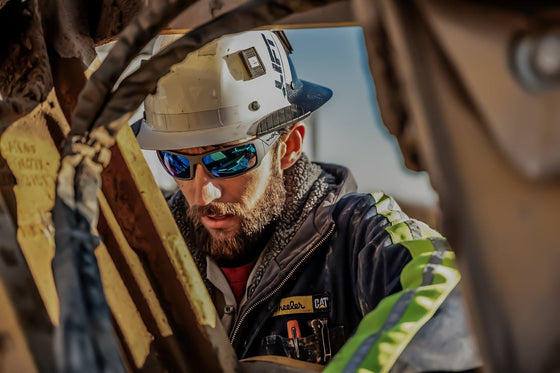

The most comfortable safety glasses for all-day wear resist fog, fit without pinching or sliding, and look good enough to stay on: an anti-fog lens in a close-fitting wraparound such as the Wiley X Saber, or a Heat Wave Vise a tech would wear off the clock. Anyone who needs correction should get a prescription-ready Z87 frame.
Walk through a tire shop or a fabrication floor around two in the afternoon and count the safety glasses. Not the pairs clipped to a collar or pushed up on a cap. The pairs actually sitting over someone's eyes. That number is always lower than the one on the safety poster by the time clock, and the gap between them is exactly where eye injuries happen.
That gap is the real safety eyewear compliance problem, and it has almost nothing to do with whether the glasses meet the standard. Every credible frame already passes. The question is whether anyone keeps them on past the first hour of a hot shift.
Z87 is the floor, not the finish line
The ANSI Z87.1 mark tells you a lens survived impact testing and will not shatter into a cornea when a bead seater lets go or a wire wheel throws a strand. The standard is set by the American National Standards Institute, and OSHA requires rated eye protection anywhere there is a risk of flying particles, chemical splash, or harmful light. Every frame worth selling carries the mark. So the question was never "is this rated." It was "will he keep it on." A rated pair in a drawer protects nobody, and the audit sheet that says you bought a thousand of them does not see a single bare face.

The real cost of skipping it
NIOSH counts about 2,000 U.S. workers a day with a job-related eye injury that needs medical treatment. Each one is lost hours, a possible ER visit, and in a small shop, a job that does not get finished. The math almost always favors a frame people will actually wear over a cheaper one they will not. Compliance is not a paperwork problem. It is a downtime problem wearing a paperwork costume.
Compliance breaks in three predictable places
Fog is the first. A worker walks from an air-conditioned counter into a hot bay, the lens hazes over, and he pushes the glasses up to find the valve stem. Now they are on his forehead, protecting his hairline. Anti-fog coatings are not a luxury feature here. They are the difference between a lens that stays down and one that becomes a headband.
Fit is the second. Safety glasses that pinch at the temples or slide down a sweaty nose come off, full stop. Wraparound frames like the Wiley X Saber seal closer to the face and stay put through a full shift. A frame that moves is a frame that gets taken off.
Looks are the third, and nobody likes to say it out loud. A technician who thinks his eyewear looks goofy will find a reason to leave it at the bench. Hand him a Heat Wave Vise he would wear to the lake on Sunday, and the compliance problem quietly solves itself. He keeps them on because he wants to, not because a sign told him to.

Eye protection follows the same rule as a good ratchet. The one he keeps within arm's reach is the one that does the job.
Match the frame to the job
Compliance climbs when the eyewear actually fits the task instead of being one generic pair for everyone:
- Grinding, cutting, demolition: a sealed Z87+ wraparound that blocks debris from the sides.
- Bright outdoor work: a tinted, ideally polarized Z87+ lens so people are not squinting past the glare and lifting the glasses to see.
- Indoor bays and low light: a clear Z87+ lens, so protection does not cost visibility.
- Anyone who needs correction: a prescription-ready Z87 frame, covered in its own section below.
The prescription gap is bigger than most shops plan for
On any crew, a real share of the team needs vision correction, and the usual workaround is readers jammed under a wraparound, or no protection at all because the rated options never came in their script. Prescription-ready Z87 frames take that excuse off the table: one worker, one pair, rated and corrected, with nothing balanced on top of anything else. For a manager, that is the difference between a program that holds and one that quietly leaks at the exact spots where people need glasses most.
How to actually choose for a crew
You can buy a thousand compliant pairs, hit your number, and still walk the floor at two and count bare eyes. The shops that move the needle treat eyewear like any tool a tech reaches for without thinking. Run past the Z87 mark quickly, because everything credible has it, and spend your attention on the three things that decide whether the pair lives on a face or in a drawer: does it fog, does it fit, and will he wear it where people can see him. Get those right and the safety poster starts telling the truth.
Common questions about safety eyewear compliance
What does the Z87 mark actually mean?
It certifies the frame and lens passed ANSI Z87.1 impact testing. A plus sign (Z87+) means it also passed the high-velocity test. Here is the full breakdown of the markings.
Are anti-fog safety glasses worth the extra cost?
On a hot or humid floor, yes. Fogging is the single most common reason workers push protection onto their foreheads, which defeats the entire point of buying it.
Can safety glasses be made in my prescription?
Yes. Prescription-ready Z87 frames put the correction in the rated lens itself, so a worker who needs glasses gets one pair that is both corrected and protective.
Do regular sunglasses count as safety glasses?
No. Only eyewear carrying the Z87 mark is rated protection, no matter how rugged a normal pair looks.
How do I get a crew to actually wear them?
Stock frames they would choose on their own, solve fogging, and make sure anyone who needs correction has a prescription option. Compliance is a product problem before it is a discipline problem.
Outfitting a team? See our corporate safety-eyewear program, or shop the full Z87 lineup.