
To stop safety glasses from fogging, wear a lens with a hydrophilic anti-fog coating and protect it: rinse before wiping, clean with water and mild dish soap, blot with a clean microfiber, and keep alcohol and ammonia cleaners away. A frame with brow venting helps in the hottest work, and once the coating wears out, replace the lens.
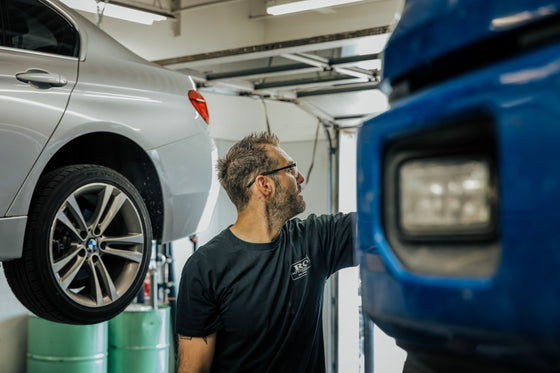
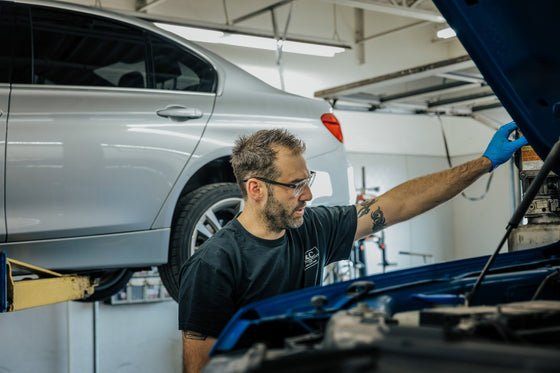
You feel it before you see it. You step out of the air-conditioned office into the bay on a July afternoon, or you lean down over a hot engine, and the world goes soft and white at the edges. Two seconds later the lens is a sheet of gray and you are working blind, so the glasses come off and ride up onto your forehead. Fog is the quiet reason most safety glasses fail. The lens never breaks. Somebody just takes it off, and a pair parked on a forehead stops nothing.
Why a lens fogs in the first place
Fog is dew, the same dew that beads up on a cold glass of tea in summer. Warm air holds a lot of water vapor and cool air holds less, so when warm, damp air, the kind off your face, your breath, or a steaming radiator, touches a lens that is even slightly cooler, the vapor turns back into liquid. It lands as thousands of tiny domed droplets, and every dome bends light its own way. Your eye reads all that scatter as a white haze. The lens is not dirty. It is wearing a coat of microscopic water, and the colder the lens and the wetter the air, the faster it piles on.
This is why fogging is worst in the exact spots a tire shop puts you. A closed bay traps summer humidity, a mount-and-balance station runs warm, and a car pulled in out of the rain leaves the place damp. Step into a cold morning with a warm face, breathe up once, and the inside of the lens is gone.
What an anti-fog coating actually does
An anti-fog coating does not keep water off the lens. It changes the shape the water takes. Most anti-fog layers are hydrophilic, which is a long way of saying they love water and pull it flat. Instead of beading into thousands of light-bending domes, the moisture spreads into one thin, even, see-through film. The water is still sitting right there. You just look straight through it, because a flat sheet of water bends light the way a flat lens does, all in one direction, so your eye never registers it as haze.
A fresh anti-fog lens can feel tacky the first time you touch it, quick to smear under a thumb. That is the coating doing its job, and it is why you treat one with more care than a bare lens.
Anti-fog does not keep the water off the lens. It spreads the water so thin you forget it is there.
The Z87 mark says nothing about fog
The Z87 stamp is an impact and optics rating, and that is the whole of it. It tells you the lens took a steel ball fired at speed and held, and that it will not warp what you see. It says nothing about whether the lens fogs. A frame can be fully Z87+ and still white out like a bathroom mirror, because the impact mark and the anti-fog coating are two separate things living on the same pair of glasses. When a label says anti-fog, that is the manufacturer's own coating and the manufacturer's own claim, not part of the safety rating. OSHA leans on the Z87 standard for impact protection in its eye and face protection rule, and the standard is maintained by ANSI and ISEA, but none of that promises a clear lens. So you look for both marks: Z87+ for the hit, anti-fog for the haze. Our Z87 safety sunglasses carry the rating, and the anti-fog versions add the second half.
Why the anti-fog wears off
This is the complaint nobody warns you about. The glasses work great for a month, start fogging again, and it feels like a defect. Usually it is just wear. A hydrophilic coating is a thin surface layer, and a few everyday habits strip it fast. Wiping a dry, dusty lens drags grit across it like fine sandpaper. A shirttail or a shop paper towel does the same, only slower. Alcohol wipes, ammonia glass cleaner, and the solvent haze in any bay can dissolve the layer outright. Every coating has a lifespan too, so even a babied pair gives up in the end.
You can stretch it. Rinse the lens under water first so the grit floats off before anything touches it. Use a drop of plain dish soap and your fingers, not a dry rag, then air dry it or blot with a clean microfiber instead of scrubbing. Keep the alcohol and the Windex away from it. None of this makes a coating immortal, but it is the difference between a pair that fogs again in a month and one that holds for a season. When the coating is finally spent, swap the lens instead of shoving a foggy pair up onto your head.
When a coating is not enough
Coatings have limits, and in the wettest, hottest work they hit a wall. Two other things move the needle. The first is airflow: a frame with a little venting up at the brow lets warm, damp air escape instead of pooling against the lens, which is why some open frames fog less than a sealed pair with no coating at all. The catch is coverage, since the same gaps that vent steam let in dust and mist. The second is fit. A close wraparound like a Wiley X seals out the air-gun cloud, but it also traps warm breath, so on a sealed frame the anti-fog coating is doing the heavy lifting and is worth paying up for. Brands that grew up in snow and performance eyewear, like Smith, have spent years fighting fog, and that work carries straight over to the bay. The same principle shows up in ski goggles, which use a dual-pane lens with a trapped pocket of air so the inner surface never drops to the dew point. Keep a lens warmer than the air around it and fog has nothing to grab onto.

Common questions
Do anti-fog safety glasses really work, or is it marketing?
They work, inside limits. A real hydrophilic coating spreads condensation into a clear film instead of letting it bead, so the lens stays see-through where a bare lens would white out. What it cannot do is last forever or beat a sealed steam bath. Treat it as a coating you maintain, not a fixed feature of the glass.
Why did my anti-fog glasses start fogging after a few months?
The coating wore off. Dry wiping, paper towels, alcohol or ammonia cleaners, and plain age all strip a hydrophilic layer, and once it is gone the lens behaves like any uncoated one. Rinsing before you wipe and using only water and mild soap buys more time, but a worn coating means a fresh lens.
Can I add anti-fog to glasses that don't have it?
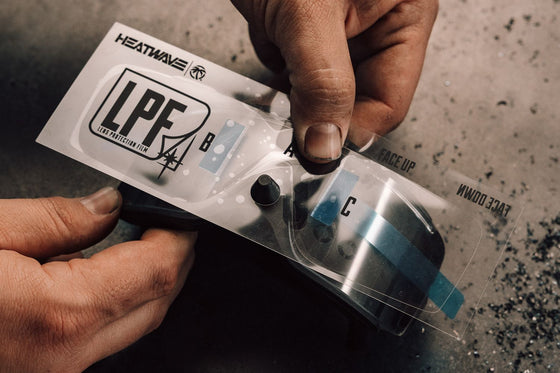
Up to a point. Aftermarket sprays and wipes lay down a temporary version of the same hydrophilic film and help for a shift or two at a time. They never match a factory coating for durability, and they need reapplying. For work you do every day, a lens with the coating built in is the better buy.
What lens should I run if fogging is my main problem?
Indoors at the machine, a clear anti-fog lens keeps you honest about what you are looking at, so start with our clear lens collection and look for the anti-fog versions. If you move in and out all day, keep a tinted pair within reach too, so you are never squinting through the wrong one or going without.
Does my whole crew need anti-fog, or just the guys who complain?
If one tech fogs up at a station, the rest will too, because it is the room and the work doing it, not the person. Outfitting a crew with anti-fog from the start cuts the glasses-on-the-forehead problem across the board. Our corporate safety eyewear program is built for kitting a shop at once.
A clear lens that stays clear is the one that stays on your face, and that is the only lens protecting anything. Start with our clear lens collection and pick the anti-fog version that fits the way your bay runs.