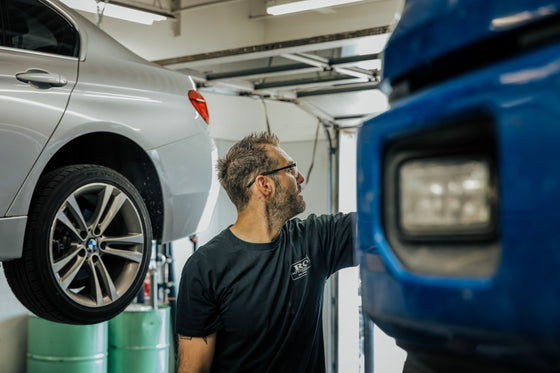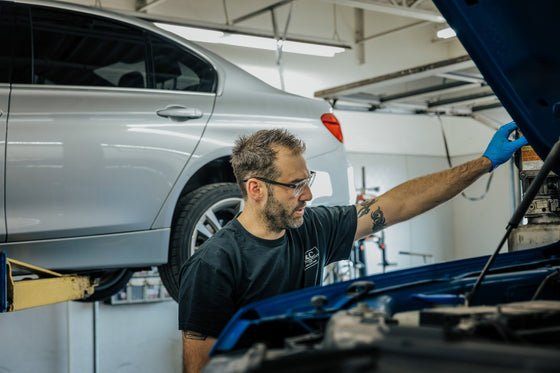

Tire shop technicians need safety glasses with the Z87 mark on frame and lens, Z87+ for impact work, in a wraparound frame that covers the sides, with a clear lens at the machine and a gray or polarized lens out on the lot. An anti-fog coating keeps them on near the balancer, and the worst chemical pours call for a sealed goggle or face shield over the glasses.
A tire bay is a quiet room until it isn't. Most of a shift is hoses and the stutter of the impact gun and somebody's radio playing low. Then a bead seats with a crack like a starter pistol, or an air nozzle kicks a chip of dried brake dust off a rotor at the speed of a thrown rock, and for half a second the air is full of small fast things looking for somewhere to land. A lot of the time they land on a face.
The bead is a slingshot
Seating a tire bead means forcing air in until the rubber pops onto the rim. When it goes right, it is a loud bang and a clean seat. When it goes wrong, the tire can let go of the rim and throw whatever was riding on it: talc, rubber crumb, a flake of the old wheel weight, a stray strand of steel belt wire that has been waiting in the carcass since the tire was built. None of it is heavy. All of it is moving fast, and your eyes are usually about two feet away and pointed right at the work.
Mounting and demounting are messy in the same way. The bar slips, the lube sprays, the bead breaker sends little bits of everything sideways. You can stand off to one side for some of it, but you cannot do the job from across the room.
The air gun does the most damage
The blow gun is the tool that gets people. Techs use it to clear a bead seat, blow out a wheel well, dry a rim after a wash, chase a bead that refuses to set. It is fast and it is everywhere, and it turns settled dust into a cloud that goes straight up toward the face. Brake dust is the worst of it, because it carries fine metal and, depending on the pad, a little silica, and it is exactly the size that does damage without you ever feeling it arrive.
OSHA caps compressed air used for cleaning at under 30 psi at the nozzle for this reason, and asks for chip guarding and eye protection on top of that. You can read the rule itself at OSHA 1910.242. Most shop lines run at 90 to 120 psi, so the regulator and the nozzle are doing real work to hold that number down. The eye protection is the part that does not depend on anyone remembering to adjust a regulator.
Rust, valve stems, and wheel weights
The slow hazards are metal. A corroded valve stem can snap when you pull the cap or seat a new core. Rust flakes off a neglected lug seat the second you touch it with a wire wheel. And the clip-on wheel weight is a small lead or steel projectile that lives on a part designed to spin, which means a balancer can fling one across a bay at head height if it was never crimped on right. The fleck that takes an eye out is rarely dramatic. It was sitting on the wheel when the car rolled in, and you put your face near it because that is the job.
The fleck that takes an eye out was on the wheel when the car rolled in. Nobody ever sees it coming.
Chemicals don't give you a warning
Then there is the wet stuff. Acid-based wheel cleaner, bead lube, tire shine, the solvent sprays like brake cleaner that techs reach for without thinking. Spray any of them at a wheel and some of it comes back as fine mist, especially in a bay with a fan running. A splash of acid wheel cleaner is a different kind of emergency than a metal chip, and ordinary glasses with a gap at the top and sides do almost nothing against a mist that drifts. This is where wraparound coverage earns its keep, and where the worst pours and mixes call for a sealed goggle or a face shield over the glasses. OSHA lays out the baseline requirement in its eye and face protection standard.
What actually works in a bay
Start with the mark. Anything you wear in a bay should carry the Z87 stamp, and for impact work you want the plus. Z87+ means the lens passed the high-impact test, a quarter-inch steel ball fired at 150 feet per second with nothing reaching the eye. If you want the full breakdown, our explainer on the Z87 mark goes deep on what those impact tests actually prove.
After the rating, fit is the thing that matters, because the glasses you take off are the glasses that don't protect you. Indoors at the machine, a clear lens keeps you honest about what you are looking at, and our clear lens collection covers that. Out on the lot pulling cars or on a quick test drive, glare off glass and chrome becomes the problem, and a gray or polarized lens from our polarized collection handles it without throwing off how a paint code reads. If you are not sure which tint goes where, the rule of thumb is clear inside at the machine, gray or polarized out on the lot.
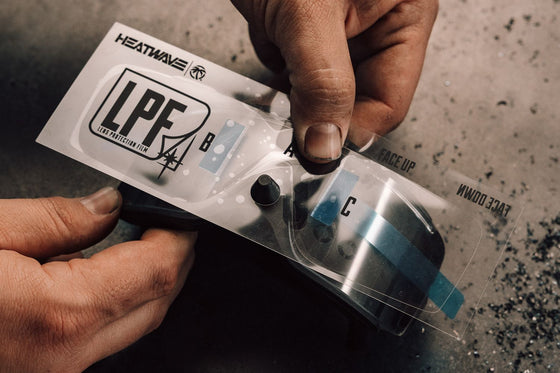
For the dustiest, gun-heaviest work, a sealed frame that sits close to the face, like a Wiley X, keeps the air-gun cloud out better than an open pair. For the tech who treats safety glasses as optional, the move is buying a pair that looks like the sunglasses he would wear anyway, which is the whole reason ChaosRXOptics stocks street-styled Z87 frames from Heat Wave Visual and others. A foggy lens gets pushed up onto a forehead, so look for an anti-fog coating if you work next to the heat of a mount-and-balance station. You can see the rated range on our Z87 safety sunglasses page. The smart glasses are a real thing now, but save the camera-equipped pair for the drive home, because a lens with a camera in the corner is not bead-seat protection.

Common questions
Do I really need Z87 glasses just to change tires?
Yes. Between the air gun, the bead seat, and the rust, a tire bay throws exactly the kind of small fast debris the Z87 impact test is built around. Regular sunglasses can shatter inward, which is worse than nothing. Look for the Z87 or Z87+ mark on both the frame and the lens.
Will safety glasses fog up next to the tire machine?
They can, since a mount-and-balance station runs warm and a closed bay traps humidity. An anti-fog coating handles most of it, and a frame with a little venting helps with the rest. A lens that fogs is a lens that ends up on a forehead, so this is worth paying for.
Can I just wear my normal sunglasses on the lot?
Only if they carry the Z87 mark. Plenty of street sunglasses offer zero impact protection, and the moment you walk back into the bay you are unprotected. A Z87-rated pair that happens to look good, like the street-styled frames in our Z87 collection, covers both.
What lens tint is best for a tire shop?
Clear indoors at the machine, gray or polarized outside on the lot. If your shop has you moving in and out all day, keep both within reach instead of squinting through the wrong one.
If your shop runs on impact guns and air lines, the eyes doing the work deserve the rated pair. Start with our Z87 safety sunglasses and pick the lens that fits the way your bay actually runs.