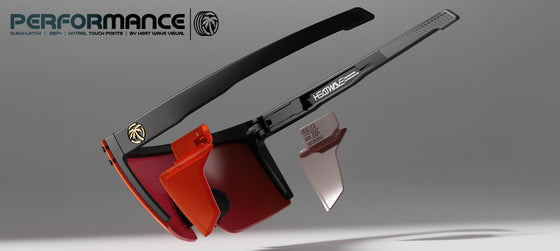
Heat Wave Visual vs Spy Optic Safety Glasses
Heat Wave Visual and Spy Optic come from the same corner of the eyewear world. Both grew up around motorcycles, skateparks, race trucks, and desert dust, and both build frames that look better off the clock than most safety glasses have any right to. So when a tech or a weekend rider asks which one to buy, the honest answer starts with a question the marketing photos skip: do you actually need the frame to pass ANSI Z87.1, or do you just want a pair that looks the part. The two brands answer that question very differently, and the difference is the whole story.
Where each brand starts
Heat Wave builds for the bay first and the boulevard second. The safety rating is the default setting, not an upgrade. Walk through the Heat Wave lineup and most of the core frames carry a Z87.1+ mark molded into the temple, which means they passed both the high-velocity and high-mass impact tests, not just the basic drop-ball. The styling rides on top of that. You get a frame that takes a flung wheel weight and still looks like something you would wear to a bar.
Spy comes at it from the opposite side. Spy is a sunglass house. The brand made its name on lens tint, contrast, and the Happy Lens story, and the Z87 rating shows up on a shorter list of frames and, on some models, only on select colorways. That is not a knock. It is a different promise. Spy is selling you mood, optics, and a look. The safety certification is available if you pick the right frame, but it is not the reason the company exists.
Heat Wave Visual: the rating is built in
The frame that proves the point is the Heat Wave Vise. It is a flat-top rectangular workhorse, rated Z87.1+ with the mark on the frame, and it runs from about $55 for a standard tint up to $80 once you add polarization. It comes in black, tortoise, or a vapor clear frame that disappears against your face. If you want something that wraps tighter and seals against dust and wind, the Heat Wave Quatro is a $80 polycarbonate shield rated for the same high-velocity and high-mass hits, built for the bay, the track, and the trail.
What you are buying with Heat Wave is breadth. There is a marked, impact-rated frame for round faces, oval faces, wide faces, clear-lens indoor work, photochromic light changes, and full-dark polarized glare. The brand-wide buyer breakdown lives in our Heat Wave Visual buyer's guide, and the Vise gets its own deep dive in the Vise guide if you want the fit notes before you commit.
The real split is simple. Heat Wave sells a safety frame that happens to look good. Spy sells a great-looking frame that, on the right model, happens to be safety rated.
Spy Optic: lifestyle first, Z87 on the right frame
Spy's safety credibility lives mostly in one frame worth knowing: the Spy General, Dale Earnhardt Jr.'s signature model. Select colorways of the General are built to pass ANSI Z87.1, and it pairs that with Spy's Happy Lens contrast tech, Trident polarization, a Grilamid frame that shrugs off abuse, and rubber nose and temple grips. It starts around $120 and climbs with the polarized and premium lens options. For a Spy buyer who genuinely needs the rating, the General is the frame to put on the short list.
The catch is what sits next to it. A frame like the Spy Cyrus is a gorgeous square sunglass with the same Happy Lens story, but it is not a Z87 safety frame, and nothing on the page pretends it is. That is the trap with shopping Spy for the bay. The brand mixes rated and unrated frames under the same look, so the badge matters more than the name. If you want the full picture of which Spy frames carry the mark, the Spy Optic buyer's guide walks the line model by model.
Price, and what the money buys
The gap is real. A marked Heat Wave Vise runs $55 to $80. A Z87 Spy General starts around $120 and the polarized builds push past $150. For that premium you get Spy's lens science and a frame with serious heritage, and some people will happily pay it. But if the job is outfitting yourself, or a couple of techs, with frames that have to be rated and have to survive being sat on, dropped, and left on a hot dash, Heat Wave gives you two or three rated pairs for the price of one Spy. Cost per rated frame is where Heat Wave pulls ahead.
One thing neither brand fixes for free is the standard itself. The Z87 mark and the Z87+ mark are not the same promise, and if that distinction is fuzzy, the ANSI Z87.1 explainer spells out exactly what the plus sign earns you before you spend a dollar on either label.

Which one belongs on your face
Pick Heat Wave if the rating is non-negotiable and you want range, repeatability, and a price that lets you keep a clear pair and a dark pair in rotation without flinching. Pick Spy if you are a sunglass person first, you want the Happy Lens experience, and you are willing to shop carefully so the frame you love is also the frame that passes. Both are real options inside the Z87 sunglasses shelf. The mistake is assuming any frame from either brand is rated. Check the temple, every time. And if you came in cross-shopping against Wiley X too, the Heat Wave vs Wiley X breakdown covers that matchup head to head.
Common questions
Are all Spy sunglasses Z87 rated?
No. Spy is a sunglass brand first, and only specific models, on some models only specific colorways, are built to pass ANSI Z87.1. The Spy General is the clearest example of a rated Spy frame. Many popular Spy frames, like the Cyrus, are not safety rated, so check the listing and the temple mark before you count on it for the bay.
Is Heat Wave Visual actually safety rated or just styled to look like it?
It is genuinely rated. Core Heat Wave frames like the Vise and Quatro carry a Z87.1+ mark molded into the frame, which means they passed both high-velocity and high-mass impact testing. The lifestyle styling sits on top of a real certification, not in place of one.
Which is better for tire and auto work?
Heat Wave, for most shops. The marked Z87+ frames are cheaper to replace, come in clear and tinted options for indoor and outdoor bays, and are built around impact first. Spy can work if you choose a rated frame like the General, but you pay a premium for lens tech that matters more on the water or the trail than under a lift.
Does Spy's Happy Lens make a real difference?
For glare, contrast, and long days in changing light, the lens tint and polarization are where Spy earns its price. If your priority is impact protection and budget across several pairs, that lens premium is less of a factor, which is part of why the two brands suit different buyers.
Still deciding between a frame that is rated by default and a frame you have to shop carefully to get rated? Start with the marked options on the Z87 safety sunglasses page and match the frame to the face before the badge to the brand.